Background of the project
During the last two decades, Fuerteventura (one of the Canary Islands in Spain) has developed extensively, and sea transported bulk freight has increased by more than 80% (Consejo de Usuarios del transporte Marítimo y Aéreo de Las Palmas [CUTMAP], 2005). These developments, coupled with the demographic predictions, have prompted decision to build new seaport infrastructures that will meet future social objectives. Puerto del Rosario, Fuerteventura’s most important seaport, has a 305 m long ocean cruiser pier. Consequently, an 84-m extension is needed to create better mooring conditions for the 280 m long ocean-going cruise ships.
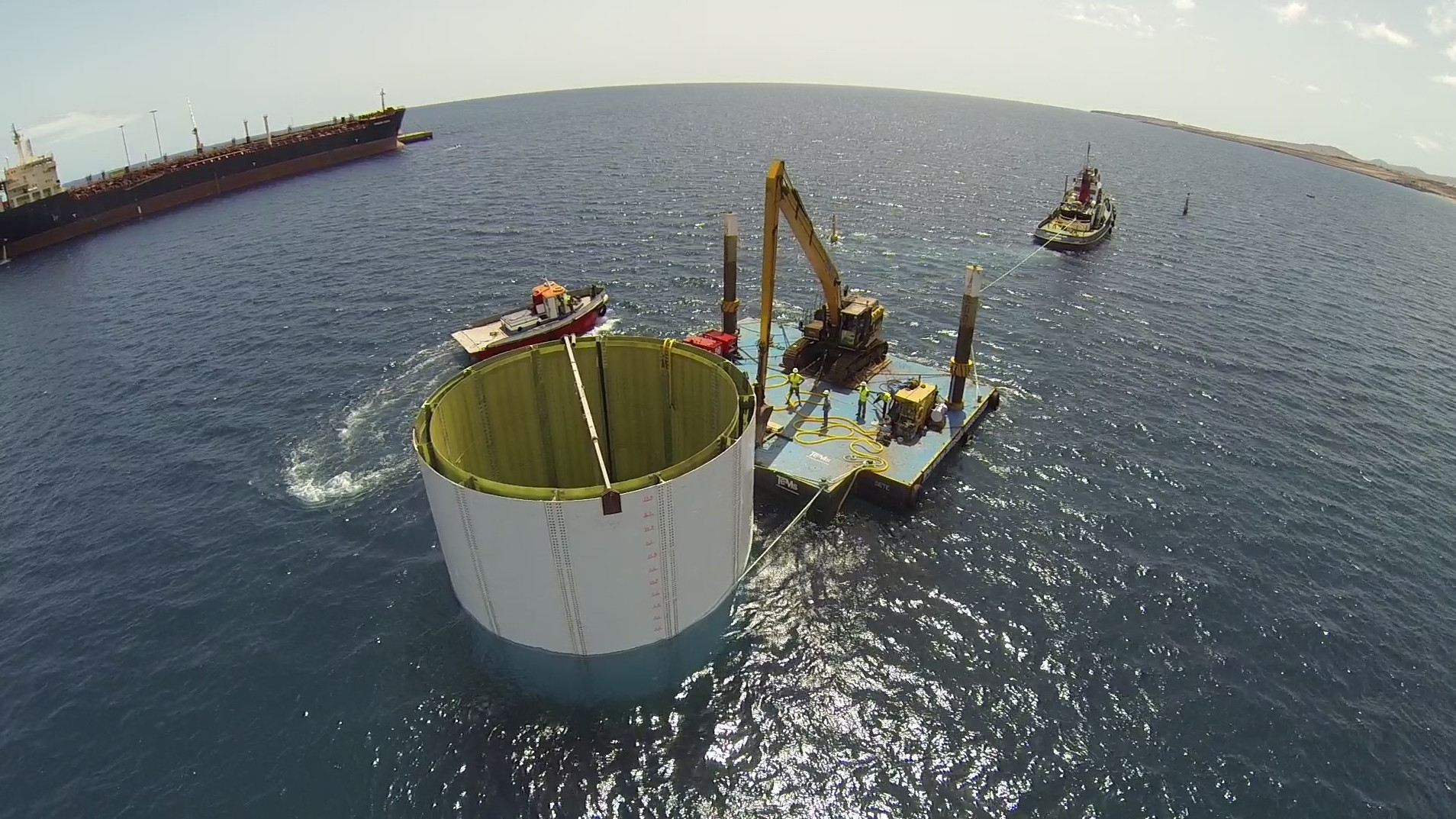
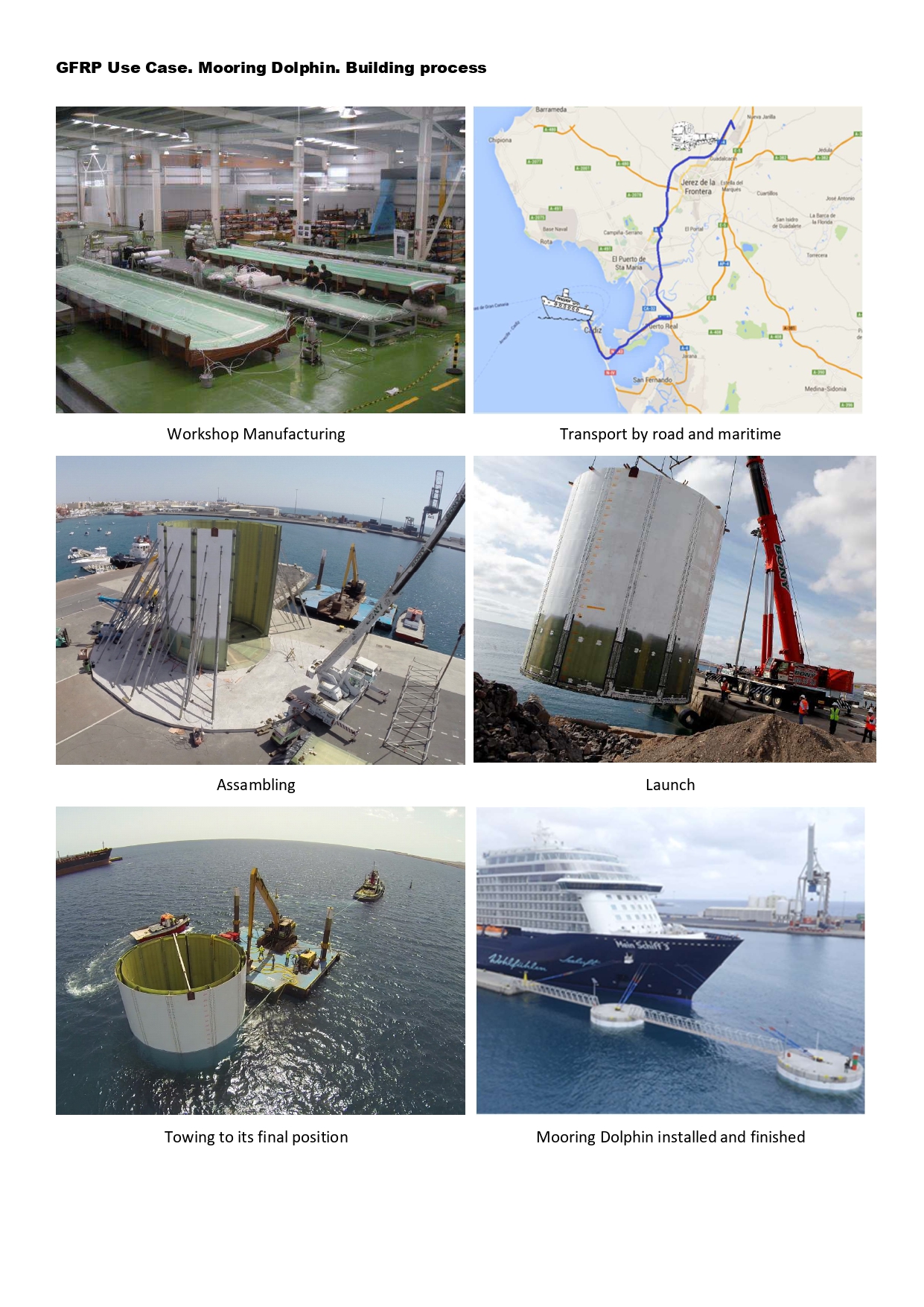
In 2012, Las Palmas Port Authority, which controls Puerto del Rosario, decided to build two square 12×12 m wide mooring dolphins, separated by 30 m, using concrete blocks (see Figure 1). As there were no-floating caisson manufacturing ships in Puerto del Rosario or in the surrounding seaports, this was an exceptional opportunity to design and test a new glass/epoxy (GFRP) caisson construction technique using pre-fabricated elements that would be transported to Puerto el Rosario for assembly on site. Lightweight GFRP caissons allow light cranes to be used to assemble all of the elements and launch the final caisson.
Description of the technique
To take advantage of GFRP’s outstanding tensile properties, the mooring dolphins were designed as cylinders. As circumferential stresses were the most important forces in the design – soil pressure inside of the caisson is double the external water pressure, most of the cylindrical structure was tensile stressed. Consequently, a 12 m diameter, 13.3 m high cylindrical GFRP caisson was designed and filled with soil to prevent sliding or turning (see Figure 2-a-b). At the top of the GFRP cylinder, a 2-m reinforced concrete slab that rests over the GFRP walls was added to fix a bollard for the installation of the mooring points. Moreover, this concrete slab was used to distribute loads into the GFRP cylinder in the event of ships colliding with the mooring dolphins. The concrete slab was not considered to be supported by the soil filling the GFRP cylinder, but rather, it was considered to be supported by GFRP caisson walls. As the concrete slab’s own weight is an important compression load on the GFRP cylinder, a second cylinder was placed inside, separated by 0.5 m, with 24 vertical stiffeners to prevent buckling. At the bottom of the GFRP cylinder, there was a composite sandwich panel slab foundation with vertical and radial stiffeners. When the GFRP cylinder was finally installed, a 0.5-m concrete slab was also poured into the bottom. This slab was placed once the composite structure was launched into the sea. The composite structure’s design weight for this first GFRP caisson was 21,000 kg. This is important as it enables the caisson structure to be launched with a light crane, which in turn enables the pre-fabricated elements to be used in the caisson. In comparison, this option is 50 times lighter than the traditional concrete alternative, which could not be pre-fabricated in a similar manner. All designs and calculations have been performed according to established design standards. For the specific case of Puerto del Rosario’s new mooring dolphins, the design fulfilled all required margins of safety, according to Recommendations for Maritime Works (Spanish Standards, 2011), the Spanish Concrete Design Code (Spanish Standards, 2008), and the Eurocomp Design Code (Clarke, 1996).
SOURCE
- Caissons made of composite in Puerto del Rosario, Fuerteventura
- Glass fiber-reinforced polymer caissons used for construction of mooring dolphins in Puerto del Rosario harbor (Fuerteventura, Canary Islands)
- From Julius Caesar to Sustainable Composite Materials: A Passage through Port Caisson Technology
Leave a Reply