The Granada metro, a pioneer in the fight against noise and vibration
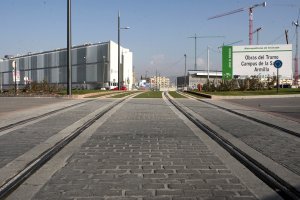
Zero noise and zero vibrations. This is what the neighbors and passengers who wait for the metro in the section that runs from the Health Campus to Armilla or what is the same, in the Technology Park, will be able to hear and feel.
The so-called ‘Granada Light Rail System (MLG), a pioneer throughout Spain and Andalusia, aims to minimize environmental impact and noise with a mixture of rubber from tires out of use (NFU) and polymer matrix resin, which will achieve a high level of vibration attenuation. The great beneficiaries of this revolutionary project will undoubtedly be the closest buildings.
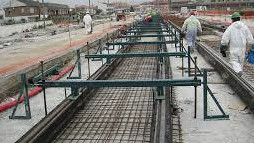
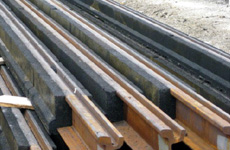
According to the director of the ‘Department of Implementation and Innovation. R&D&I Technology Centre, Acciona Infraestructuras’, José Daniel García Espinel, “the basic objective of the system is to introduce this damping element between the rail and the concrete slab by means of the previous realization of a jacketing of the same, being understood as such the impregnation of the rail with a primer resin, and subsequently introduced into a mold filled with the mixture of NFU and resin, to which pressure and temperature are exerted for curing’. The direct application of this mixture on the rail guarantees the adhesion of the jacketing, avoiding any slack and empty space. “However, the dimensions of the jacketing have a very strict control in terms of its geometry, in order to carry out the welding between rails a length of one meter is left and the procedure is done in situ,” says this civil engineer.
The advantages of the project
The Manager of Projects and Works of the Granada Metro, Alberto Sánchez López assures that for the realization of this route seven tires have been reused for each linear meter, “which means a total of 5,211 wheels in 400 meters of double track”. “If it has been applied in this section and not in another, it is fundamentally because the Technology Park is an ideal place to innovate and provide new aspects in everything that has to do with R + D + I”, continues Sánchez.
For his part, the president of the Metropolitan of Granada Project, Francisco Ruiz Dávila affirms that this initiative is “very important for the city”, since with the help of the company in charge of this section, the project will serve as a reference for the rest of the Spanish provinces where you want to implement, in addition to placing Granada at the forefront of technology, it can be said that it is a milestone within the development of railway technology.”
Both García Espinel and Sánchez and Ruiz Dávila agree in exposing as one of the main advantages of this new technique, the environmental. But in addition, the civil engineer José Daniel García highlights as other virtues of the ‘MLG’, “the high attenuation of vibrations. Of the 6.3 hertz and 20 kilohertz, an overall decrease of more than 20 decibels is achieved, taking into account that the passage of a tram through the city generates, under normal conditions, vibrations per terrain of 85 decibels; apart from the high comfort that it will mean for the traveler by guaranteeing the geometry of the road”.
In the same way, it will also allow an easy commissioning, “since it is a single monolithic block without the possibility of takeoffs or lack of adhesion; the low maintenance cost, since it has no mechanical fixings and achieves greater durability of the rail, which can be between 20 and 25 years old; and the circulation of non-rail vehicles on the track. Any relief vehicle will be able to pass through this platform and non-rail car traffic will cross the adjacent streets,” he clarifies.
Granada at the forefront
As for the economic cost, the manager of Projects and Works of the Granada Metro, Alberto Sánchez López maintains that it is being similar to that of other sections, where it is carried out in a more traditional way, with the only difference that in the Technology Park the route will try to be more respectful with the environment.
Francisco Ruiz Dávila concludes that the future development of this technology, “applied to other areas”, opens the door to research projects in which “new alternatives for plate track systems that can be used both in the underground metro, as in the conventional railway and high speed” are created.
SOURCE
- El metro de Granada, pionero en la lucha contra el ruido y las vibraciones
- Desarrollo y experimentación del sistema M.L.G. (Metro Ligero de Granada). Primer sistema nacional de via en placa embebida en hormigón realizado con una mezcla de caucho procedente de neumáticos fuera de uso (NFU) y resina de matriz polimérica
Leave a Reply